

Citizens of all 27 EU member states and the wider Schengen Area do not need a visa to visit Israel, but they do need an approved ETA-IL (Electronic Travel Authorization) before boarding any flight or ship. The ETA-IL costs NIS 25 (about USD 7 / EUR 6.50), takes minutes to apply for online, and is valid for two years with multiple entries allowed. This guide covers everything EU and Schengen citizens need to know about the Israel ETA – from eligibility and documents to the step-by-step application process.
Do EU Citizens Need a Visa for Israel?
No. All European Union member states are on Israel’s list of visa-exempt countries. Citizens of France, Germany, Italy, Spain, the Netherlands, Poland, Sweden, Belgium, Austria, Portugal, Denmark, Finland, Ireland, Greece, Czech Republic, Romania, Hungary, Bulgaria, Croatia, Slovakia, Slovenia, Lithuania, Latvia, Estonia, Luxembourg, Malta, and Cyprus can enter Israel without a traditional visa.
The same applies to citizens of Schengen Area countries that are not EU members – Norway, Iceland, Switzerland, and Liechtenstein. All of these nationalities qualify for the ETA-IL instead of a visa.
However, since the introduction of the ETA-IL system, visa-free no longer means paperwork-free. Every EU and Schengen passport holder – including children and infants – must obtain an approved ETA-IL before traveling to Israel. If you hold both EU citizenship and Israeli citizenship, you should enter on your Israeli passport and do not need an ETA-IL.
For a full list of exempt nationalities, see our guide to Israel visa requirements.
ETA-IL Requirements for EU Citizens
Before applying, make sure you have the following ready:
| Requirement | Details |
|---|---|
| Valid EU/Schengen passport | At least 6 months validity beyond your entry date; must be machine-readable |
| Digital passport photo | JPEG or PNG, 50-500 KB, minimum 600×600 pixels, white background |
| Email address | Active email you check regularly – approval is sent here |
| Payment method | International credit or debit card (Visa, MasterCard, Amex) |
| Travel details | Optional: intended entry date, flight number, accommodation in Israel |
Your passport number in the application must match exactly what appears on your passport’s biographical page. Even a single-digit error can cause a mismatch at the airport and result in denied boarding.
For a full breakdown of every document and specification, see our ETA-IL requirements guide.
How to Apply for Israel ETA from the EU
The entire application is done online through the Israel Population and Immigration Authority (PIBA) portal. Here is the step-by-step process:
Step 1: Visit the official PIBA website
Go to the official ETA-IL application portal. Avoid third-party websites that charge extra service fees – the official application costs only NIS 25.
Step 2: Fill in your personal details
Enter your full name (exactly as it appears on your passport), date of birth, nationality, passport number, and contact email.
Step 3: Upload your photo
Upload a digital passport-style photo that meets the specifications listed above. The system will check the format and size automatically.
Step 4: Answer eligibility questions
You will be asked about your travel history, criminal record, and health status. Answer honestly – providing false information can result in denial.
Step 5: Pay the fee
Pay NIS 25 (approximately USD 7 / EUR 6.50) using an international credit or debit card. The fee is non-refundable, even if your application is denied.
Step 6: Submit and wait for approval
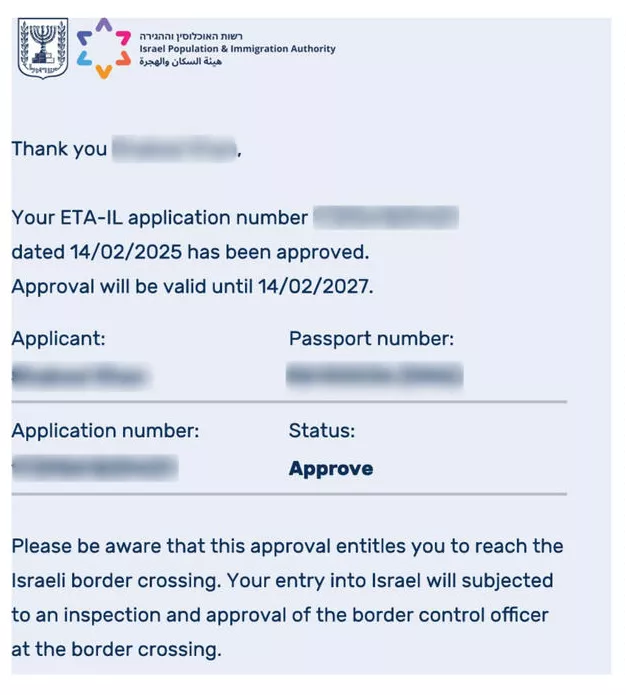
Most applications are approved within minutes, though some may take up to 72 hours. You will receive your approval by email.
For a detailed walkthrough with screenshots, visit our how to apply for Israel ETA guide.
How Much Does the Israel ETA Cost for EU Citizens?
The ETA-IL costs a flat NIS 25, regardless of nationality. For EU citizens, this converts to approximately:
| Currency | Amount |
|---|---|
| NIS (Israeli New Shekel) | 25 |
| USD | ~7 |
| EUR | ~6.50 |
| GBP | ~5.50 |
The fee is per person – if you are traveling as a family, each member including children needs a separate application and separate payment. There are no discounts for families or groups.
Payment is non-refundable. If your application is rejected for any reason, you will not get your money back. You can, however, correct any issues and reapply (with another payment).
For more on fees and accepted payment methods, see our ETA-IL fee guide.
How Long Does Israel ETA Processing Take?
For EU citizens, the ETA-IL processing is typically very fast:
| Processing Stage | Typical Timeframe |
|---|---|
| Standard processing | Minutes to 24 hours |
| Extended review | Up to 72 hours |
| Peak travel season | May take slightly longer |
Most EU applicants receive approval within minutes of submitting their application. However, PIBA recommends applying at least 72 hours before your planned departure to account for any unexpected delays or additional screening.
If your application requires additional review, you will receive an email notification. This does not mean your application has been denied – it simply means a manual check is needed. You will receive a final decision by email.
For more details on processing timelines, see our ETA-IL processing time guide.
How Long Is the Israel ETA Valid for EU Citizens?
Once approved, your ETA-IL is valid for:
- Duration: Up to two (2) years from the date of approval
- Or until: Your passport expires, whichever comes first
- Entries: Multiple entries allowed during the validity period
- Stay per visit: Up to 90 days per entry
If your passport expires before the two-year validity period, your ETA-IL expires with it. You will need to apply for a new ETA-IL with your new passport number.
If your ETA-IL expires while you are already in Israel, do not panic – the authorization only needs to be valid at the time of entry. You can remain in Israel for the duration of your permitted 90-day stay, even if the ETA-IL expires during that time.
Note that the 90-day stay limit is consistent with the Schengen Area’s own 90/180-day rule that Israel applies in reverse. If you are a frequent traveler to Israel, plan your visits accordingly.
Israel ETA vs Visa: What EU Citizens Need to Know
| Feature | ETA-IL | Israel Visa |
|---|---|---|
| Required for EU citizens? | Yes | No (unless staying over 90 days or working) |
| Application method | Online | In-person at embassy/consulate |
| Cost | NIS 25 (~EUR 6.50) | Varies by visa type (EUR 20-200+) |
| Processing time | Minutes to 72 hours | Weeks to months |
| Validity | Up to 2 years | Varies by visa type |
| Max stay per entry | 90 days | Varies by visa type |
| Multiple entries | Yes | Depends on visa type |
If you plan to stay in Israel for more than 90 days, work, study, or engage in religious activities, you will need a specific visa type. EU citizens who exceed their 90-day ETA-IL stay without obtaining an extension may face fines, deportation, or future entry bans.
For a detailed comparison, see our Israel ETA vs visa guide.
Tips for EU Citizens Traveling to Israel
- Apply early. While most approvals come in minutes, apply at least a week before travel to avoid stress.
- Check your passport. Ensure at least six months validity from your entry date. EU passports vary in validity periods – check the expiry date now.
- Print or save your approval. While the ETA-IL is stored electronically, having a printed copy or screenshot of your approval email can be useful if airline staff ask for proof.
- Keep your email active. All official correspondence comes via email. Do not use a work email you might lose access to.
- Travel insurance. While not required for the ETA-IL, comprehensive travel insurance is strongly recommended. Israel has excellent healthcare, but medical costs for visitors can be high. Your European Health Insurance Card (EHIC) may not cover you in Israel – check before you travel.
- Arrive prepared. At Ben Gurion Airport, have your passport and ETA-IL ready. Border control may ask about your accommodation, return flight, and purpose of visit.
- Schengen re-entry planning. Remember that time spent in Israel counts against the Schengen Area’s 90/180-day rule for non-EU nationals. As an EU citizen this does not apply to you within the EU, but it matters if you hold dual citizenship with a non-EU country.
What Happens If My Israel ETA Application Is Rejected?
If your ETA-IL application is denied, you will receive an email explaining the reason. Common reasons for rejection include:
- Passport number mismatch
- Invalid or non-compliant photo
- Incorrect personal information
- Previous immigration violations in Israel
- Security-related concerns
A rejected application does not prevent you from reapplying. You can correct the issue and submit a new application with a new fee. If you believe the rejection was made in error, you can contact PIBA directly or apply for a traditional visa through the Israeli embassy in your country.
FAQs About Israel ETA for EU Citizens
Do citizens of all EU countries need an Israel ETA?
Yes. Citizens of all 27 EU member states – including France, Germany, Italy, Spain, the Netherlands, Poland, Sweden, Belgium, Austria, Portugal, Denmark, Finland, Ireland, Greece, Czech Republic, Romania, Hungary, Bulgaria, Croatia, Slovakia, Slovenia, Lithuania, Latvia, Estonia, Luxembourg, Malta, and Cyprus – need an approved ETA-IL before traveling to Israel.
Do Swiss and Norwegian citizens need an Israel ETA?
Yes. Citizens of Switzerland, Norway, Iceland, and Liechtenstein (Schengen Area countries that are not EU members) also need an ETA-IL to enter Israel. All are on Israel’s visa-exempt list.
Can I apply for an Israel ETA on behalf of my family?
Yes, but each family member needs a separate application and separate payment. There is no group or family application option. You can complete multiple applications in one session using the same device.
Do children with EU passports need an ETA-IL?
Yes. Every traveler, regardless of age, needs their own ETA-IL. This includes infants and newborns. Children must have their own valid EU/Schengen passport to apply.
Can I work in Israel with an ETA-IL?
No. The ETA-IL is for tourism, business meetings, and transit only. To work in Israel, you need a B1 work visa. To study, you need an A2 student visa. See our Israel visa types guide for more information.
What if my passport expires while my ETA-IL is still valid?
Your ETA-IL is linked to your passport number. If your passport expires, your ETA-IL expires with it – even if the two-year validity period has not ended. You will need to apply for a new ETA-IL with your new passport.
Can I extend my stay beyond 90 days?
The ETA-IL allows stays of up to 90 days per entry. To stay longer, you must apply for a visa extension through the Israel Population and Immigration Authority before your 90 days expire. Overstaying without authorization can result in fines and future entry bans.
Is the Israel ETA the same as a visa on arrival?
No. The ETA-IL must be obtained before you travel – you cannot get it at the airport. Airlines may deny boarding if you do not have an approved ETA-IL. Apply at least 72 hours before your flight.
Can I use the ETA-IL to enter Israel by land?
Yes. The ETA-IL is required for entry by air, sea, and most land border crossings. If entering from Jordan or Egypt by land, make sure your ETA-IL is approved before reaching the border.
Does the ETA-IL affect my Schengen 90/180-day count?
No. The Schengen 90/180-day rule limits how long non-EU nationals can stay in the Schengen Area. As an EU citizen, you have the right to live and work in any EU country without time limits. The 90-day limit on the ETA-IL applies to your stay in Israel only.